

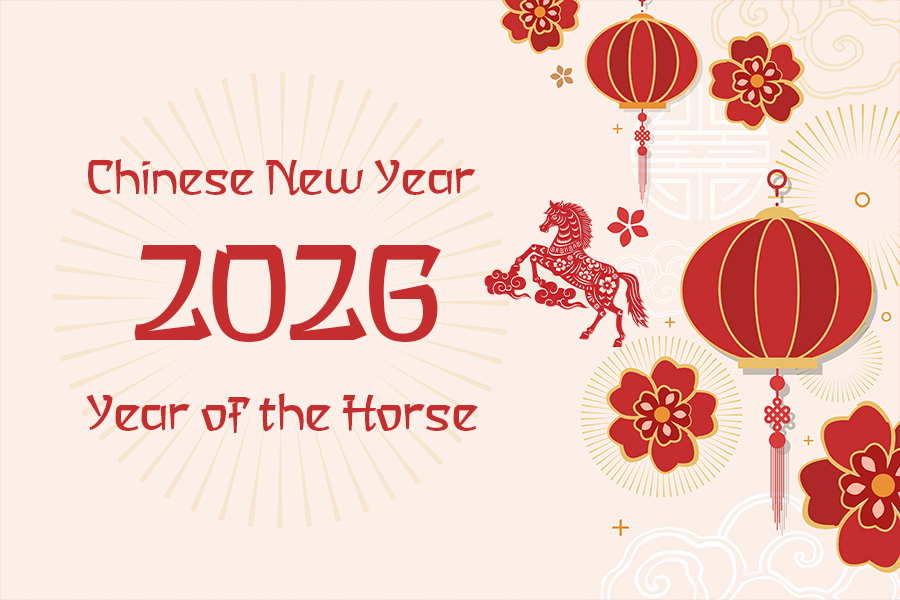
Even though the New Year 2026 in the US is long gone, China’s New Year celebration is around the corner. This year’s Chinese New Year falls on Tuesday, February 17th – Tuesday, March 3rd, 2026, Lantern Festival. China uses two calendars, combining them for daily use and holiday celebrations: one lunar and the other Gregorian. It’s often referred to as a yin (阴历) and a yang (阳历) calendar. This is the year of the fire horse; it’s a rare, high-energy, 60-year cycle event symbolizing intense passion, rapid change and innovation. The fire element amplifies the Horse’s natural traits of independence, intelligence and vitality, creating a fast-paced and potentially volatile year.
The New Year celebration is welcomed in by deep cleaning (扫年), to sweep away bad luck. Focusing on organization and cleaning the house inside and out, focusing a lot on hidden and high-traffic areas. While cleaning, typically brooms and mops are avoided on the first day as well as scissors, as it’s thought to sweep away/cut good fortune. It is also a good time to repair broken or old items.
After sweeping the bad luck away comes the decoration, to welcome prosperity. All the decorations shall be up by New Year’s Eve. Red couplets (春联), a traditional decoration typically featuring red and gold, symbolize good fortune, happiness, and wealth. These couplets will be on both sides of the door and one will be used to create a rhyme or meaning, commonly used to express wishes for the future. In the center space of every door will be placed a diamond-shaped red paper with the character for “luck” (福) in the center of the door. For some, they place it upside down, which comes from a story of a blind old man and his grandson accidentally putting decorations upside down. When the emperor was about to punish them, the empress explained: “Having the (福) character upside down (倒了) sounds the same as (到了), meaning that he wants the luck to be pouring into your empire, and arriving at you.” And from that day on, it became a tradition in the Chinese New Year. Additionally, putting the (福) character on every door of the house means giving everyone good luck. Every year, the zodiac animal motif pairs with this year’s zodiac sign.
Other house decorations, like placing a blooming flower as a centerpiece or a potted plant near windows represents growth and renewal, and kumquat trees (“gold oranges”) in the living room or lobby are meant to bring wealth. One common family decoration is paper cuttings (剪纸), which brings much interaction for every family member. Family members cut designs from mainly traditionally red paper, using scissors. Afterwards, tapping on the window for wishes, luck, happiness, abundance (fish motif), and longevity (peach motif). Red lanterns are very common as well, symbolizing happiness, warmth and warding off bad luck.
The Reunion Dinner (年夜饭) is the most significant annual gathering of the year; family members come together no matter how far by traveling, driving, or taking a train. The biggest part of the reunion is about the food, the mother is typically the chef and the husbands and children will be the helpers. Having the food on the table not only feeds every member who has gathered, but also contains meanings towards the new year.
“My mom owns a restaurant, so she brings food home, stuff like fried shrimp, enoki mushrooms, Chinese sausage and I am not sure of the name, but fish cake,” junior Tina Lin said.
The shrimp is associated with joy, the enoki mushrooms are often associated with longevity. Chinese sausage is a sweet, air-dried pork sausage flavored with rose water or rice wine. Rice cakes are consumed during the New Year because it represents having a surplus year. These traditional foods are consumed on the eve of the New Year. Besides these, giving money is the most well-known tradition for the Chinese New Year.
The red envelope containing money is a gift also used for weddings, graduations, birthdays, or thank yous. On this occasion, the envelopes will usually be given to married people, elders and the young to wish them luck. But to the kids, this was their way to get pocket money to last until the next new year.
“My parents give out red envelopes, give money to the children, and we put up decorations. We usually have noodles and other stuff in the hot pot,” Lin said.
Shousui (守岁) or watching over the year, meaning staying up till midnight. Usually, there will be no designated time to go to bed as long as it’s past midnight. Behind this tradition is the idea of staying awake to protect people against the Nian beast (年兽). This beast appeared lion-like with a sharp horn, sometimes depicted with a dog-like body. Every new year, the beast would come down from the mountain or out of the sea and cause chaos in the village. Then an old, wise man uses the color red, bright lights, fire/lanterns, loud noises, and firecrackers to scare away the beast. Even after the Nian beast is nowhere to be seen, people still consider it an important part of the Chinese New Year tradition.
On New Year’s Day, people would visit family members and friends (拜年), and the time period can last about three to five days. Everyone would wear new clothes in bright colors, showing a great start to the year. When visiting, as a guest, you should always bring gifts to show respect. By bringing a red envelope with fresh fruits, tea, or snacks. As a Host, you welcome the guest with a clean space, being polite and offering them snacks. When they settle down, conversations about how their year has been, children’s Grades, work, etc, can be brought up. These visits can strengthen family connections, seeing family members who are far away.
Chinese New Year centers on family reunions, honoring traditions, and welcoming the new year. Evolving the Zodiac sign for the year, cleaning, red decoration, foods, watching over the year, fireworks, visiting, greeting and the story behind traditions.





Lijie • Feb 25, 2026 at 9:50 am
This was a really well-written and thoughtful piece! The explanations of the traditions and their cultural meanings were clear, detailed, and engaging. I especially enjoyed learning about the symbolism behind the decorations and the stories connected to them. It’s great to see such a rich cultural celebration shared in such an accessible way. Wonderful work!